

What is the washing machine used for? 1
How the washing machine works. 2
Washing machine installation and connections 4
What is the washing machine for?
The washing machine is one of the appliances that has most changed domestic life. Created to save time for housewives and now also for single men, the washing machine makes life much simpler and quicker for those who want to take care of their clothes.
In a short time, the washing machine can remove stains, wash, and wring out garments of various materials and colors, with specific programs for each. With economical programs that run short and mimic hand washing, and with the help of certain products and detergents that prevent color bleeding, washing clothes and linens becomes increasingly simple and quick.
In some cases, the garments are also dried, so not only does hand washing go unnoticed, but hanging them up is also a thing of the past. The latest washing machine models are increasingly energy efficient, offering greater performance even in limited space, and offering ever-increasing functionality combined with striking design.
All this breadth of choice makes choosing a washing machine quite complicated . That’s why we’ve put together a specific guide to help you when making your purchase.
How the washing machine works
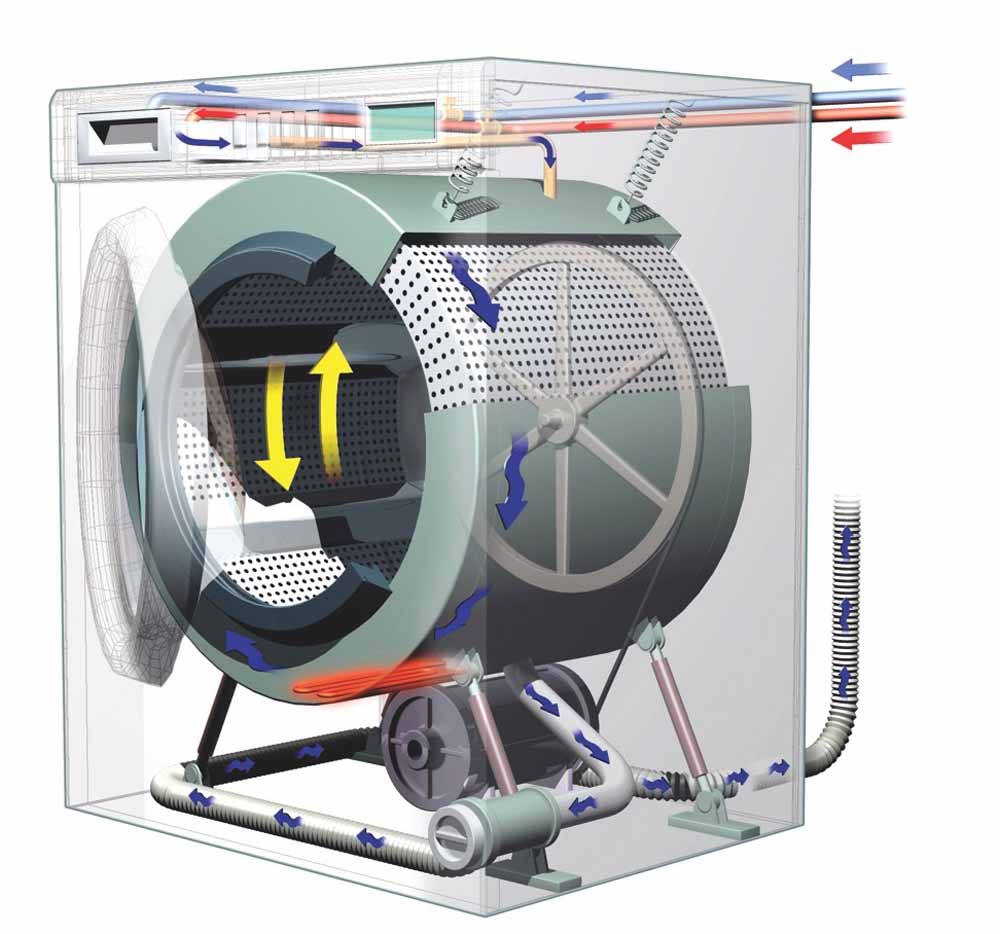
Washing machines mostly use water mixed with detergents, fabric softeners, and stain removers. This appliance uses a soaking technique: the garments are immersed in water mixed with detergent, heated by an internal heating element to the temperature set in the program and regulated by a thermostat.
The rotary movement of the drum in which the clothes are placed removes dirt from them.
In addition to the soaking technique, there is another one that is quite effective on stains, the “rain” technique, or RWS recirculation wash , which consists of a forceful spray of water and detergent coming from above.
Washing phases
With these principles, the operating phases of the washing machine, which can vary depending on the models and the programs set, are essentially:
- prewash
with a detergent inserted in a special compartment before switching on - water heating
, through resistance - washing
with temperature and duration established by the program - rinse
- spin
with fixed speed or set manually or by program - drying
in the case of a washer dryer
Centrifuge
The spin cycle is the function that, activated automatically by the various programs or set manually, simply put, makes the drum containing the laundry spin very quickly, immediately after washing (the spin cycle is not even designed for some garments, such as wool for example, as the latter would risk felting).
This way, it is as if the laundry were wrung out and therefore deprived of most of the water it absorbed during the wash.
In practice, the stronger the spin cycle, the faster the laundry will dry.
Each washing machine model has its own spin cycle, which can be more or less powerful: from a minimum of 800 rpm, or 800 revolutions per minute, up to over 1500 rpm.
A spin speed of 800 rpm maximum may be fine if you also have a tumble dryer or are able to dry your clothes quickly, while if your situation is not as just described, you need a spin speed of at least 1000 or even 1500 rpm.
Furthermore, the spin cycle in a washing machine can be of two types:
- fixed
is found in models where the number of revolutions cannot be set: the speed is therefore, in fact, fixed, it does not change regardless of the programme set - variable
is the one whose speed changes according to the set program or which can be set manually by the consumer.
Obviously, the variable spin cycle is best, also because more delicate items require a less powerful spin cycle, as they could get damaged.
Washing machine washing programs
Security systems
Washing machines are also usually equipped with several safety devices that make their operation more efficient and reliable, preventing water from leaking from the appliance and flooding the floors, or worse, coming into contact with the washing machine’s electrical wiring. Some washing machine safety devices include:
- anti-overflow system
whereby a sensor monitors the maximum water limit in the drum, blocking the flow if this level is exceeded, thus avoiding flooding in the house - anti-flooding system
which has the same objective as the previous system and which is activated if the anti-overflow system has not operated correctly for some reason: the anti-flooding system blocks the washing machine if there is an actual leakage of water from the appliance - water stop
which blocks the machine in the event of faults in the loading and unloading pipes.
Washing machine installation and connections
There are essentially three places suitable for installing a washing machine in a house :
- Kitchen
- bath
- laundry room or designated hallway
In the first two cases, the water and electricity connections already present in the two utility rooms of the house are used. In the third case, however, the washing machine is placed in its natural habitat, a room specifically designed for laundry care. First of all, the location for installing the washing machine must be chosen based on several variables:
- space available, and therefore the size of the washing machine itself
- load needed to wash all the laundry in a house
- location for loading and unloading water, as well as electrical sockets
- convenient location and easy to reach
- distance from other appliances, such as dishwashers or refrigerators
- silence or noisiness of the washing machine itself
Once you have chosen the position that best meets your needs according to the variables mentioned above, pay close attention to the attacks already mentioned, which must be:
- water loading connection
- Drain connection to the sewer, through which the washing machine discharges used and dirty water; it is important that the drain pipe is very resistant, as it must not break if subjected to pressures higher than normal; the pressure resistance limit is usually set at 60 bar.
- Connect to the electrical network in the immediate vicinity of the washing machine. The home electrical system must be compliant and grounded, and must be capable of at least 3 kW of power.
Washer-dryer
A washer-dryer is an appliance that combines the functions of both a washing machine and a dryer. In this case, after the spin cycle, which can be as low as 800 rpm, the drying phase begins. This ensures your clothes are both washed and dry .
Furthermore, in the washer-dryer’s technical data sheet, you will find data relating not only to washing, but obviously also to drying.
A washer-dryer is a space-saving alternative to installing a front-loading washing machine in a stack with a dryer, or a washer and dryer placed side by side.
For those who have little space available and neither the means nor the time to dry clothes naturally, a washer-dryer is the ideal solution, even if the prices are obviously higher than those of a normal washing machine.
To learn more about the features and programs of a dryer , please refer to the article on this site that discusses them in depth.





I commenti sono chiusi.