

Choosing awnings
Awnings are useful for creating cool, pleasant shaded areas and for making the most of our home’s outdoor space even in the hottest summers: terraces, balconies, and gardens thus become places to relax and have fun even during the hottest hours of the day .
Besides providing protection from the hottest rays of the sun, they can also be a decorative element on a building’s façade. Therefore, choosing them should be based on several criteria, and for this reason, it’s important to understand the features of the awnings available on the market.
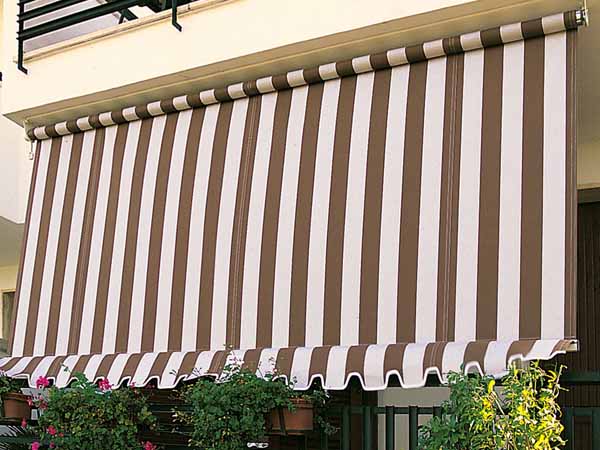
Functions of awnings
Awnings can perform various functions:
- protect an area or window (and the resulting internal environment) frequently exposed to the sun, from the rays and heat of the sun in the summer period
- protect the outside area of a house from prying eyes
- decorate the facade of a building
- create a usable environment outside a house, even in summer
- limit electricity consumption, as the protection of windows by awnings allows less heat to penetrate inside the house: in this way, both air conditioners and fans will be used less
In which environments to install them
The external elements where an awning can be placed are:
- balconies
- terraces
- solar paving
- gardens
- facades with windows or glass
Obviously, for the conditions for installing an awning to exist, the area to be covered by the awning must be frequently exposed to the sun, especially in summer.
Structural elements of awnings
An awning is made up of several elements, which are:
- fabric or cloth: it is the main part, the one that actually provides shelter
- supporting structure or frame, on which the sheet rests
- cassette , an optional element, which serves as protection for the awning when it is rolled up and therefore exposed to the elements such as rain, snow or hail
- sheet metal cover , alternative to the cassette, to protect the closed awning
Tarpaulin: which material to choose
Fabric type
First and foremost, the primary criterion for choosing an awning is the type of fabric to purchase for the canvas, the awning’s main element. To choose this element, several factors must be considered.
Awning fabrics can be natural, such as cotton. However, these materials are subject to tearing, mold, and aging caused by sun, wind, and pollution, as well as fading due to exposure to sunlight. If you choose 100% acrylic fibers, you can rest assured: these fabrics are durable, tear-resistant, and resistant to fading because they undergo a special through-body dyeing process. Furthermore, acrylic fibers are treated with resins and Teflon, giving them firmness and water-, oil-, and oil-repellent properties. As an alternative to acrylic, you can choose PVC, which has similar properties.
The awning must first of all protect the skin from the sun’s harmful rays and the protection factor of an awning varies depending on some characteristics of the fabric:
- composition of the fibres
which, depending on how they are structured, have a different capacity to absorb and therefore not transmit UV rays; synthetic fibres are the best in this sense - color
because darker shades provide a more resistant barrier not only to light but also to harmful rays, compared to lighter colors; the disadvantage of dark colors, however, is that they attract a lot of heat. - thickness
as a dense and compact weave is much more effective than a light weave in retaining UV radiation
Water resistance
The second criterion for choosing an awning fabric is water resistance , because the awning could be exposed to rain, hail or snow.
Tear resistance
The third criterion is resistance to tears , which can occur when moving the awning.
Aesthetics
The fourth criterion for choosing the fabric for awnings is finally aesthetics : shapes, colors and patterns must be compatible with the overall appearance not only of the exterior of the apartment, but of the entire building if you live in an apartment building.
Structure or frame
The awning frame is made up of:
- tubular, which supports the entire tent
- guides; where the curtains slide when they open and close
- hinges
- extendable arms
- hook supports, to hang curtains on the wall or floor
Since the structure of awnings is always exposed, even for long periods, to atmospheric agents, it is made with weather-resistant materials, appropriately treated to resist external aggressions and corrosion.
The choice of materials can be made between:
- PVC
- aluminum
- appropriately treated wood
dumpster
The cassette consists of a metal box into which the awning is completely inserted when rolled up and closed. This element protects the fabric, the most delicate part of the awning, from corrosion by the elements, especially in winter.
Types of awnings
The most common awnings are available in different types depending on their opening and closing systems and the supporting structure. Each type is best suited to a different type of outdoor space requiring protection, be it a balcony, a terrace, or a window.
awning
The arm awning is the most commonly used for balconies: it allows the awning to be opened using two extendable arms, attached to an upper bar to which the tube with the rolled-up awning is attached. This type of awning offers only top-level protection. This type of awning can be fixed to the wall or ceiling.
drop awning
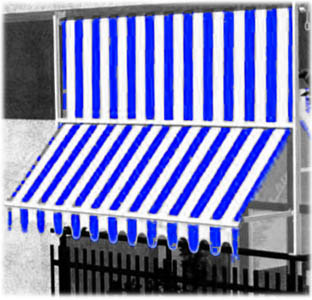
In this case, the awning, again widely used for balconies, descends vertically flush with the facade and offers frontal and lateral protection. This type can be divided into two sections:
- a higher one that falls vertically;
- a lower one that can protrude beyond the balcony to let more light and air into the balcony itself.
awning
This is a very eye-catching awning, also used for balconies or to cover windows or glass doors. It has a rounded shape, and the canvas is sewn over a curved arched frame, which is operated by a cord. It provides protection at the top and partially at the sides.
attic or side guide awning
This type is suitable and recommended for covering large areas, such as terraces, patios, or gardens. This awning offers frontal as well as top screening. The attic awning features side guides and a frame that attaches to the wall, therefore to a perimeter wall, and rests on the ground or parapet.
pergola awning
This type is used for large areas, such as terraces, flat roofs, or gardens, where a fixed structure anchored to the wall and ground can be installed. The awning or awning strips can be slid between the beams or can be opened and closed like a bundle, sliding inside pre-designed guides.
umbrella
In addition to the classic beach umbrella we’re all familiar with, there are special types of umbrellas that are a loose variant of awnings. Umbrellas allow you to shade small areas of a terrace or garden, providing both sun-exposed and shaded areas, allowing people who want to relax in the shade to coexist with those who want to sleep in the sun. Furthermore, umbrellas can be easily moved, so they don’t permanently occupy space. The stability of umbrellas is ensured by inserting their shafts into pre-drilled holes on a support base, which can be made of stone, metal, or plastic, and then weighted with special weights. The shafts supporting this type of awning can be made of wood, powder-coated steel, aluminum, or PVC.
Dimensions of awnings
Awnings, with the exception of umbrellas, are made to measure.
To design them, the size of the window and/or outdoor space to be covered is assessed (to determine the type of awning to install), as well as the building’s exposure to sunlight, to select the appropriate fabric. These characteristics can also influence the awning’s pitch and shape.
Permits in a condominium
If you wish to install an awning to cover a balcony, window, or terrace belonging to a condominium, you must obtain authorization from the condominium building, having read its Bylaws. The building building typically prohibits installing external awnings of a different type and color than those used by the condominium building without the binding approval of the assembly. However, if you wish to install awnings different from those already in the building, you must obtain the approval of a majority of the condominium members at the assembly.
Shield windows and skylights with awnings
When windows are highly exposed to sunlight, such as skylights in attics, you can use special sunshades, available in both manual and remote-controlled versions. When sunlight hits a window, it increases the heat generated inside the room. Specially designed shades block the rays before they hit the glass and filter them, reducing the heat while still creating a naturally filtered light effect inside.
Mechanisms for opening and closing curtains
Every awning structure is equipped with a mechanism to open and close the awning as needed. This mechanism can be manual, automated, or even motorized and remotely controlled. Manual systems are cheaper and often very easy to use, but they are not suitable for awnings that cover large surfaces, such as pergolas or attics. When automated and/or motorized systems are desired, there are two options:
- purchase an awning with an integrated automated and/or motorized system
- Insert a manually or automatically operated motor into your existing awning; in the latter case, installation can be done without modifying the awning’s structure, using special technologies that minimize electrical connections and avoid the need for building work.
Automated systems can be provided with additional functions:
- some sensors automatically close the awning in case of wind or rain, and prevent damage to the canvas and the structure
- other sensors, with the presence of sun, automatically open the awning to create shade
- Emergency controls allow you to open and close the awning manually using the operating rod, even in the event of a power failure
- remote control for remote operation
Safety
From 1 March 2006, according to the EN UNI 13561 regulation, all outdoor awnings must be sold equipped with:
- the CE marking;
- the reference standard
- the name and address of the manufacturer
- the declaration of conformity
- the instruction, use and maintenance manual
Also according to this regulation, outdoor awnings must:
- be subjected to laboratory tests and classified into categories from 0 to 3 (the higher the value, the higher the wind resistance capacity of the awning), depending on their wind resistance, a fundamental requirement for their safety
- possibly possess the voluntary Assites label, issued by the Italian Association of Awnings, Solar Screens and Technical Closures, which is a further guarantee of quality.
Maintenance
To maintain the strength, elasticity, and color of awning fabrics over time, you should follow some simple tips:
- Do not roll up the cloth if the fabric is very wet
- close the awning as soon as you notice it’s about to rain and reopen it once the rain has stopped, to let it dry
- Once the warm season is over, where it has been used a lot, clean the awning with the help of a brush or a not too hard sponge, combined with water and neutral detergent
- Do not clean with pressure washers or steam equipment, which could damage the water-repellent layer on the fabric, which makes it waterproof.
Websites for choosing and purchasing awnings
- Italian Association of Awnings, Solar Shades and Technical Closures
The website of the Italian Association of Awnings, Solar Shades and Technical Closures, with advice, solutions, products and useful addresses of manufacturing companies. - Parà
In the Tempotest section, fabrics for awnings are sold, with different patterns, colors and aesthetic combinations. - Velux http://www.velux.it
The company produces awnings, special covers for skylights, and offers the possibility of purchasing online through its website. - Gibus http://www.gibus.it
Each awning comes with a data sheet that details its composition, construction, finish, weight, height, light stability, waterproofing, breaking load, and fire resistance. It also indicates recommended, discouraged, and prohibited uses, as well as maintenance instructions.







I commenti sono chiusi.